
- Index
- Author
- Benson J Lossing (8)
- Benson J. Lossing (13)
- Bruce Catton (7)
- George Bancroft (8)
- God (6)
- Harper (9)
- John Esten Cooke (9)
- Ladd (6)
- Louisa May Alcott (41)
- Mixed Authors (50)
- Prof Allen E. Fowler (6)
- Rossiter Johnson (6)
- Samuel Butler (7)
- Shelby Foote (78)
- Thomas Mealey Harris (9)
- Time Life (17)
- Ulysses S. Grant (13)
- Unknown (25)
- Various (76)
- Various Authors (26)
- Other (2235)
- Binding
- Broadside (2)
- Brochure / Pamphlet (12)
- Cloth (62)
- Disbound (4)
- Fine Binding (72)
- Hard Back (2)
- Hardback (9)
- Hardcover (1067)
- Hardcover W / Jacket (3)
- Leather (368)
- Leather Bound (3)
- Manual Binding (3)
- Military & War (2)
- Original Hardcover (2)
- Paperback (2)
- Softcover (3)
- Softcover, Wraps (72)
- Other (967)
- Language
- Publisher
- Broadfoot (13)
- Bunce & Huntington (10)
- Charles L. Webster (10)
- Easton Press (121)
- Harper & Brothers (11)
- J H Moore & Company (6)
- Jones & Stanley (7)
- L. Stebbins (11)
- Marvel Comics (11)
- Morningside (20)
- Random House (22)
- Rapidan Press (6)
- Sherman Publishing (8)
- The Archive Society (6)
- The State Company (7)
- Time Life (11)
- Time Life Books (100)
- Time-life (7)
- Time-life Books (10)
- Unknown (17)
- Other (2241)
- Region
- Topic
- Agriculture (8)
- American (us) (19)
- American Civil War (9)
- American History (6)
- Bible (11)
- Books (8)
- Books, Civil War (32)
- Christianity, Bibles (76)
- Civil War (266)
- Civil War (1861-65) (1103)
- Civil War, War (6)
- Classics (48)
- English Civil War (7)
- Historical (47)
- History (14)
- Literature (9)
- Military (23)
- Religion (6)
- The Civil War (7)
- United States (20)
- Other (930)
1865 Journal State Vermont CIVIL War Abraham Lincoln Gettysburg Slavery Troops
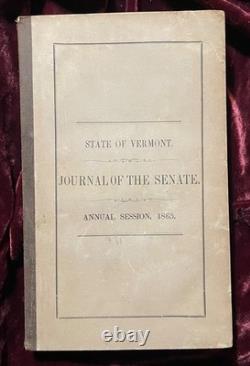


Of the State of Vermont. Montpelier: Printed at the Freeman Steam Printing Establishment, 1866. This Vermont Senate journal was for the first annual session after the Civil War, with rich potent material on Union victory, emancipation, racial equality, Vermont's military service, the Soldiers' National Cemetery at Gettysburg, Abraham Lincoln, Andrew Johnson, Reconstruction, and public thanksgiving after the defeat of the rebellion. Quite a scarce volume in this original state, perhaps the print run was small.
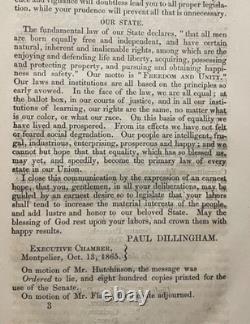
General age-wear to text and wraps, dog-earing, creasing, contents toned but generally sound. The volume opens in the first legislative year after Appomattox and Lincoln's assassination. Governor Paul Dillingham's address, dated from the Executive Chamber at Montpelier, October 13, 1865, frames Vermont's postwar obligations in fierce moral and constitutional language.He quotes the fundamental law of the state, "that all men are born equally free and independent, " and connects Vermont's own constitutional tradition to the national future after slavery. "In the face of the law, we are all equal, " he declares, at the ballot box, in our courts of justice, and in all our institutions of learning, our rights are the same, no matter what is our color, or what our race.
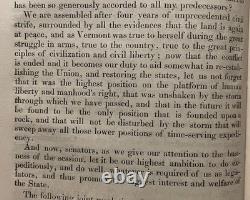
" He continues with the hope that this equality, "which has so blessed us, may yet, and speedily, become the primary law of every state in our Union. A second address passage makes the Reconstruction meaning still plainer. Speaking after "four years of unprecedented civil strife, " Dillingham reminds the legislature that Vermont had been "true to herself during the great struggle in arms, true to the country, true to the great principles of civilization and civil liberty, " and warns that as the Union is restored the state must not retreat from the highest position on the platform of human liberty and manhood's right.
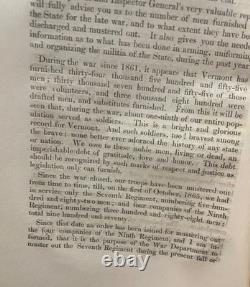
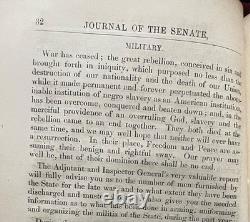
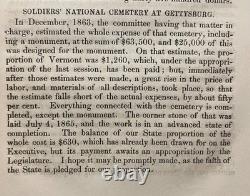
" He calls that position the only one "founded upon a rock, " and predicts that lesser positions of "time-serving expediency will be swept away. Under the heading "Military, " Dillingham writes that "War has ceased, " and that the rebellion, "conceived in sin and brought forth in iniquity, " had intended the destruction of the nation and the permanent perpetuation of negro slavery as an American institution. " He continues that rebellion and slavery "both died at the same time, " and hopes that neither will "ever have a resurrection. The address then records Vermont's extraordinary military contribution, stating that since 1861 Vermont had furnished 34,555 men, of whom 30,755 were volunteers and 3,800 were drafted men and substitutes.Dillingham notes that during the war "about one-ninth of our entire population served as soldiers, " calling this "a bright and glorious record for Vermont, " and affirming that the state owed these soldiers, living and dead, an imperishable debt of gratitude, love and honor. Soldiers' National Cemetery at Gettysburg.
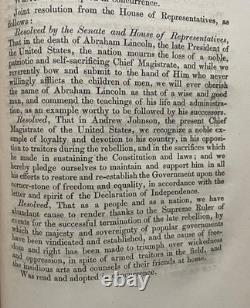
Vermont's share of the cost is discussed in detail, with reference to the original December 1863 estimate for the cemetery and monument. Also prints a notable joint resolution on the death of Abraham Lincoln, adopted by the Vermont Senate and House of Representatives. The legislature declares that in Lincoln's death "the nation mourns the loss of a noble, patriotic and self-sacrificing Chief Magistrate, " and that Vermont would ever cherish the name of Abraham Lincoln as that of a wise and good man. In the same resolution, the legislature recognizes Andrew Johnson as "a noble example of loyalty and devotion to his country, " and pledges to support him in efforts to restore and re-establish the Government upon the corner-stone of freedom and equality, in accordance with the letter and spirit of the Declaration of Independence.
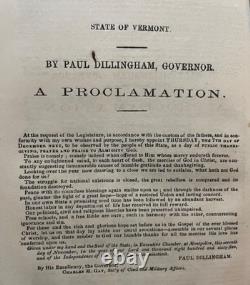
" The final resolution gives thanks for the successful termination of the rebellion, by which "the majesty and sovereignty of popular governments have been vindicated and established, " and "the cause of freedom and right" had triumphed over "wickedness and oppression. The volume further includes Governor Dillingham's printed Thanksgiving proclamation, dated November 7, 1865, appointing Thursday, December 7, as a day of public thanksgiving, prayer, and praise. The proclamation looks back over the year and asks, what hath not God done for us?"The struggle for national existence is closed, the great rebellion is conquered and its foundation destroyed, " while "peace with its countless blessings again smiles upon us, " and through the darkness of the past, gleams the light of a great hope - hope of a restored Union and lasting concord. The volumes Vermont publicly aligning its state motto of "Freedom and Unity" with the national struggle over emancipation and equality.